There is a common assumption that growth is always a sign of progress.
⦁ Higher revenue.
⦁ More employees.
⦁ Additional locations.
⦁ New products.
⦁ More opportunities.
Growth certainly feels encouraging.
But is it always taking an organisation where it truly wants to go?
That question has stayed with me throughout my career.
I’ve seen organisations that were growing rapidly, yet becoming increasingly difficult to manage.
⦁ More complexity.
⦁ More decisions.
⦁ More pressure on leadership.
⦁ More activity.
⦁ Yet surprisingly little additional value.
I’ve also seen organisations that appeared to be growing more slowly, but every decision strengthened the business they were deliberately trying to build.
It made me wonder whether growth, on its own, is ever the objective.
Or whether direction matters even more.
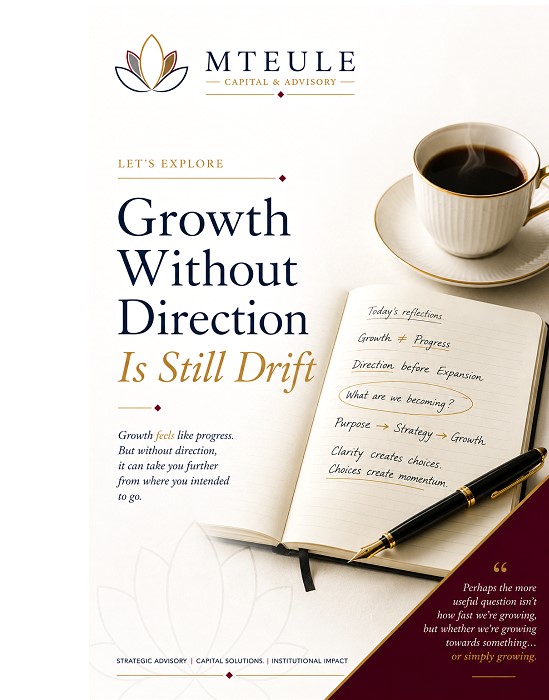
Growth has a remarkable way of disguising drift.
An organisation can become busier every year while quietly moving further away from its original purpose.
⦁ New opportunities emerge.
⦁ Markets evolve.
⦁ Customers ask for different things.
Each decision can seem perfectly reasonable in isolation.
But over time, those decisions can pull an organisation in several different directions at once.
Eventually, the question is no longer,
“How are we growing?”
It becomes,
“What exactly are we becoming?”
I’ve found that organisations with a clear sense of direction often make very different decisions.
⦁ They don’t pursue every market.
⦁ They don’t launch every product.
⦁ They don’t say yes simply because an opportunity appears attractive.
Instead, they keep asking whether each decision moves them closer to the future they are intentionally creating.
Sometimes the answer is yes.
Sometimes it isn’t.
And that clarity makes growth feel very different.
Growth becomes purposeful rather than accidental.
Expansion becomes a consequence of strategy rather than a substitute for it.
Perhaps that is why some organisations seem to become stronger as they grow, while others become increasingly stretched.
It isn’t always the pace of growth that makes the difference.
It may be the direction.
Perhaps the more useful question isn’t,
“How fast are we growing?”
Perhaps it’s,
“Are we growing towards something… or simply growing?”
I’d love to hear your thoughts.
— Nkuli Mkhize
The Best Funding Strategies Rarely Start with Funding
Capital Follows Confidence There is a common assumption in business that capital creates confidence. Raise the funding. Secure the investment.