There is a common assumption that governance begins when an organisation becomes large.
Once the business has grown.
Once investors arrive.
Once regulations require it.
Until then, governance is often seen as something that can wait.
Over the years, I’ve found myself thinking about governance rather differently.
Perhaps governance isn’t simply about compliance.
Or policies.
Or board packs.
Perhaps it’s one of the foundations that allows sustainable growth to happen in the first place.
When people hear the word governance, they often picture meetings.
Approvals.
Committees.
Reporting.
Those things certainly matter.
But good governance seems to begin much earlier.
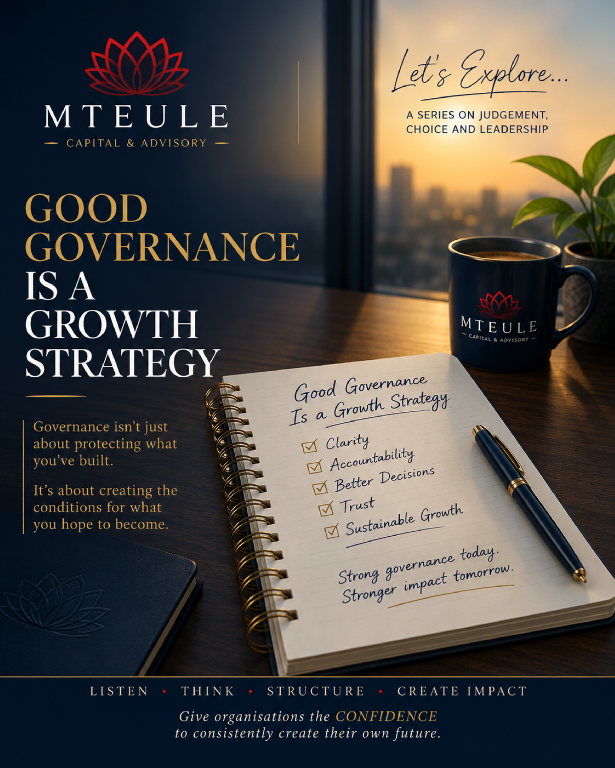
It begins with clarity.
Who makes decisions?
Who is accountable?
How are risks identified?
How are difficult conversations encouraged rather than avoided?
How are decisions documented so they can be understood long after they have been made?
Without that clarity, organisations often become increasingly dependent on individuals.
Knowledge sits with a few people.
Decisions become inconsistent.
Growth places greater pressure on systems that were never designed to support it.
For a while, the organisation may continue to succeed.
Then complexity begins to expose the cracks.
Good governance doesn’t eliminate those challenges.
But it often allows organisations to navigate them with greater confidence.
It creates consistency.
It strengthens accountability.
It helps leadership make better decisions, especially when circumstances become uncertain.
Perhaps that’s why I’ve come to see governance less as a regulatory requirement…
and more as an investment in an organisation’s future.
The organisations that seem to grow most sustainably are rarely those with the most complicated governance.
They’re often the ones with the clearest governance.
People understand their responsibilities.
Decisions are made deliberately.
Accountability is visible.
Trust has room to grow.
Maybe that’s why governance isn’t simply about protecting what an organisation has already built.
Perhaps it’s also about creating the conditions for what it hopes to become.
What do you think?
— Nkuli Mkhize
The Best Funding Strategies Rarely Start with Funding
Capital Follows Confidence There is a common assumption in business that capital creates confidence. Raise the funding. Secure the investment.