
Capital Follows Confidence
There is a common assumption in business that capital creates confidence.
Raise the funding.
Secure the investment.
Obtain the loan.
Then the organisation can begin building the future it has imagined.
Our experience has often suggested the opposite.
Confidence comes first.
Capital follows.
Not confidence in the sense of optimism.
Nor confidence built on persuasive presentations or ambitious forecasts.
Institutional confidence.
The kind that allows investors, lenders, development finance institutions and strategic partners to believe that an organisation is capable of turning today’s opportunity into tomorrow’s reality.
That confidence is rarely created by a financial model alone.
It seems to emerge from something much deeper.
A clear strategy.
Sound governance.
Capable leadership.
Commercial discipline.
A realistic understanding of risk.
And an organisation that understands not only where it wants to go, but why it deserves to get there.
When capital providers assess an opportunity, they are not simply evaluating numbers.
They are also evaluating judgement.
Can this leadership team make sound decisions under pressure?
Does the organisation understand its market?
Have the difficult questions already been asked?
Is there clarity around execution?
Are governance structures capable of supporting growth?
Financial projections matter.
But they rarely create confidence on their own.
More often, they reinforce confidence that already exists.
This may explain why organisations with similar funding requirements often experience very different outcomes.
One secures support quickly.
Another struggles for months or even years.
The difference is not always the quality of the opportunity.
Often, it is the quality of confidence surrounding the opportunity.
Confidence becomes visible in preparation.
In discipline.
In leadership.
In clarity.
This is also why our work rarely begins with an investor presentation or a funding application.
Those are important milestones.
But they are not usually the starting point.
Instead, we find ourselves asking different questions.
Is the strategy coherent?
Is the business truly investment-ready?
Does the governance inspire confidence?
Can the leadership articulate the opportunity with conviction because it genuinely understands it?
Only then do we begin talking about capital.
Because capital is often attracted to organisations that already demonstrate confidence through their preparation.
Perhaps that’s why we’ve come to believe:
Capital follows confidence.
Confidence follows clarity.
Clarity follows disciplined thinking.
If that’s true, perhaps the strongest funding journeys begin long before funding conversations ever take place.
What do you think?
— Nkuli Mkhize
Good Governance Is a Growth Strategy
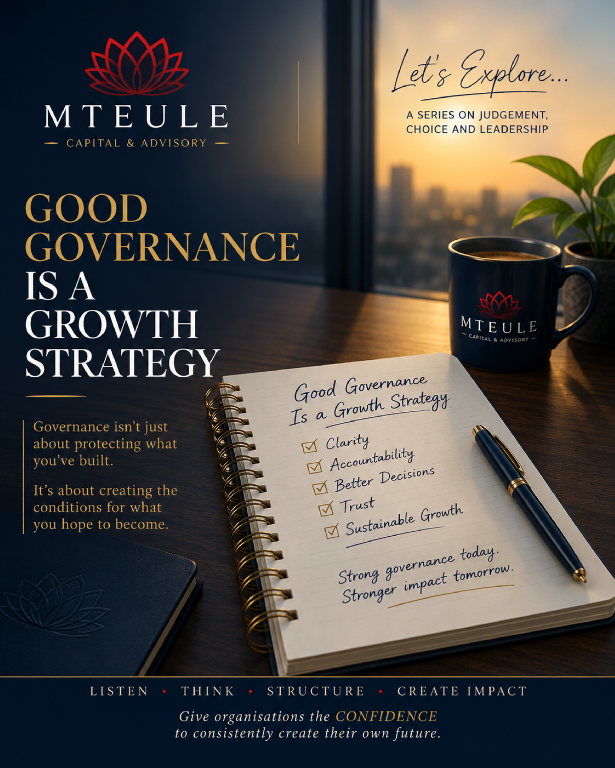
There is a common assumption that governance begins when an organisation becomes large. Once the business has grown. Once investors