There is a common perception that investment decisions are made in boardrooms.
⦁ Around large tables.
⦁ Supported by financial models.
⦁ Investment memoranda.
⦁ Due diligence reports.
⦁ Committee papers.
Those discussions are undoubtedly important.
But I’ve often wondered whether the real investment decision begins much earlier.
Long before the papers are circulated.
Long before the committee convenes.
Long before anyone votes.
Throughout my career, I’ve had the privilege of participating in investment decisions from different perspectives.
⦁ I’ve prepared opportunities.
⦁ I’ve assessed opportunities.
⦁ I’ve recommended opportunities.
⦁ I’ve sought investment for opportunities of my own.
And one observation has stayed with me.
By the time an investment reaches formal approval, much of the real decision has already been shaped.
Not by the numbers alone.
But by the quality of thinking that produced them.
Investment committees rarely create clarity.
They evaluate it.
They don’t create strategy.
They assess whether one exists.
They don’t build governance.
They look for evidence of it.
They don’t develop leadership capability.
They consider whether leadership has demonstrated sound judgement.
In many ways, the committee is responding to confidence that has been built long before the meeting ever begins.
That confidence grows quietly.
⦁ Through disciplined preparation.
⦁ Honest conversations.
⦁ Constructive challenge.
⦁ Difficult questions that are asked early rather than avoided until later.
I’ve often found that the strongest investment opportunities don’t arrive with all the answers.
They arrive with leadership that has already wrestled with the hardest questions.
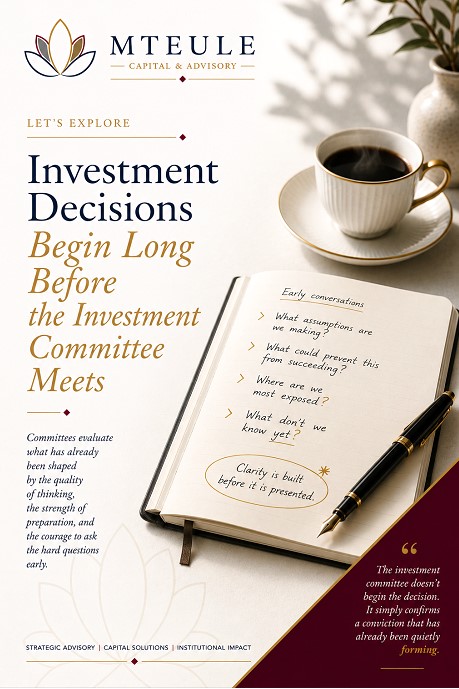
⦁ What assumptions are we making?
⦁ What could prevent this from succeeding?
⦁ Where are we most exposed?
⦁ What don’t we know yet?
Those conversations rarely appear in the final investment memorandum.
Yet they often determine its quality.
Perhaps that is why two organisations can present remarkably similar opportunities and receive very different responses.
One inspires confidence.
The other creates hesitation.
The difference isn’t always the opportunity itself.
Sometimes it’s everything that happened before the opportunity reached the room.
Perhaps the investment committee doesn’t begin the decision.
Perhaps it simply confirms a conviction that has already been quietly forming.
I’d love to hear your thoughts.
—
Nkuli Mkhize

The Best Funding Strategies Rarely Start with Funding
Capital Follows Confidence There is a common assumption in business that capital creates confidence. Raise the funding. Secure the investment.